Moisture Survey Services
Miami, FL · Capabilities
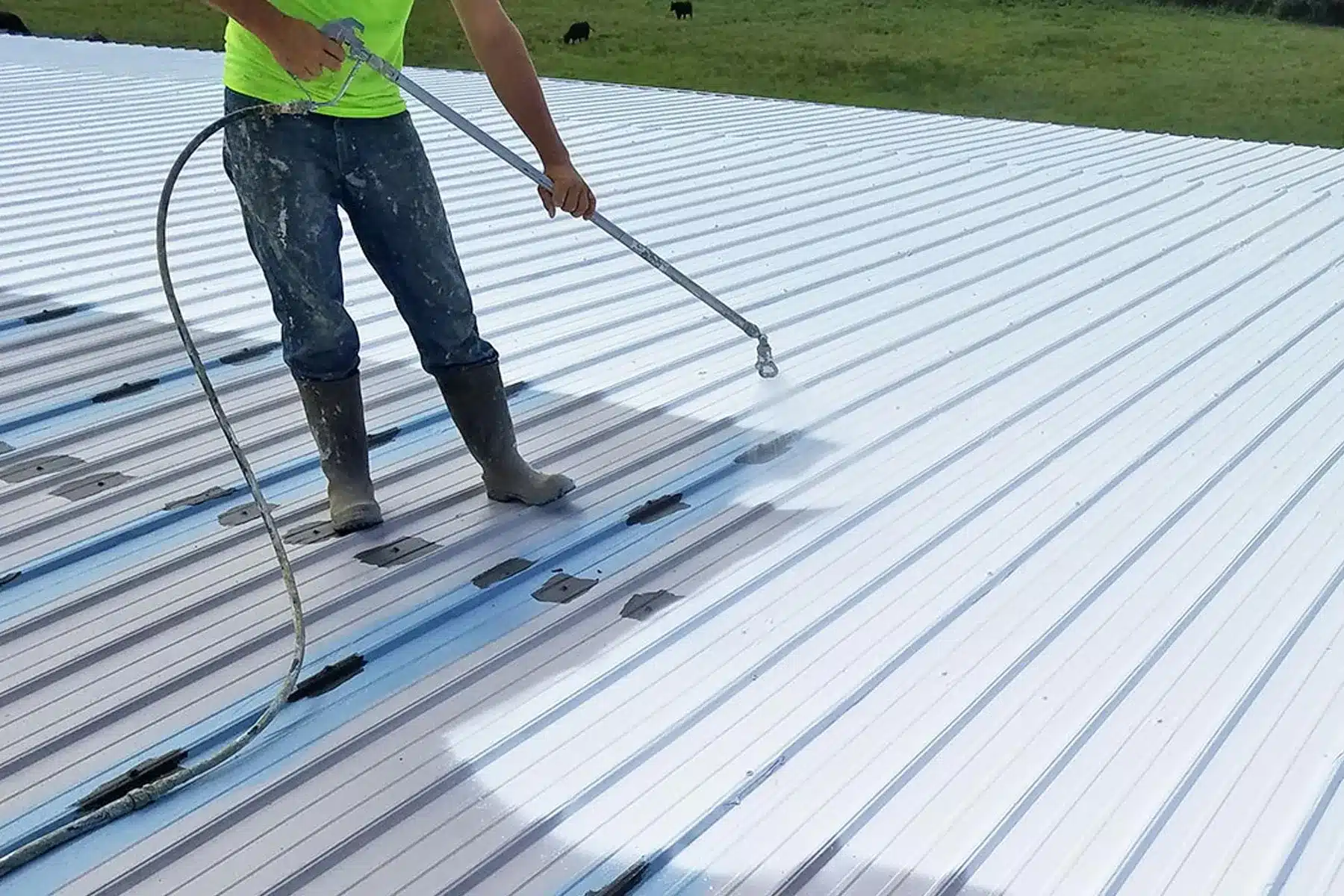
A roof in Miami can look acceptable on the surface while the insulation below it is saturated over 30 to 40 percent of its area. That moisture does not show up on a visual inspection — and it is the variable that determines whether a recover is viable or whether replacement is the only honest scope.
Miami's rainfall intensity is among the highest in the continental United States. During peak summer months, Brickell and downtown Miami regularly receive 4 to 6 inches of rain in a single afternoon thunderstorm. When that rain finds a pinhole penetration in a flat roof membrane — a hairline crack in a seam weld, a micro-breach at a poorly sealed penetration, a flashing lap that has lost adhesion — it saturates the insulation below within hours. Once insulation is wet, Miami's sustained humidity prevents it from drying. The moisture stays in the insulation, migrating laterally under the membrane, invisible to the eye from above and often invisible from below until the saturation is significant enough to push through the roof deck.
A moisture survey locates that invisible saturation. We use infrared scanning — thermal imaging that detects the temperature differential between wet and dry insulation after a clear day — combined with electrical capacitance testing for validation in areas where cloud cover or roof traffic prevents a clean infrared scan. When the survey identifies saturated zones, we pull core samples to confirm the instrument readings and document the actual insulation condition. The combined result is a saturation map of the roof that shows where moisture has migrated and how much of the total insulation area is affected.
That saturation map is the data that makes the recover-versus-replace decision honest rather than speculative. In Miami-Dade, if more than 25 percent of the roof insulation is saturated, a recover installs a new membrane over wet insulation in a climate where that moisture will never evaporate — accelerating the new membrane's degradation and voiding the manufacturer warranty. Below 25 percent saturation, a targeted insulation replacement in the wet zones combined with a recover membrane can be the right capital decision. The survey data is what separates those two scenarios from each other.
Infrared Scanning Protocol for Miami Conditions
Infrared scanning works on a specific thermal mechanism: solar energy absorbed by the roof during the day is re-radiated at night. Wet insulation retains heat longer than dry insulation because water has a higher thermal mass. In the first one to three hours after sunset, the temperature differential between wet and dry insulation zones is large enough to be detected by a thermal camera — wet zones appear warmer on the infrared image. This mechanism works well in Miami's climate, where solar loading during the day is high and the temperature drop after sunset is sufficient to create a clear differential.
Our infrared surveys are conducted in the late evening after a clear day with strong solar loading and no rain for at least 24 to 48 hours before the survey. Miami's rainy season (June through September) creates scheduling constraints — afternoon thunderstorms are frequent, and a rain event within 24 hours of the survey invalidates the thermal differential. We schedule surveys in the dry season (November through April) when possible, or during dry windows in the rainy season.
The infrared survey produces a thermal image of the roof with wet zones visible as warmer areas. We map these zones against the roof zone diagram. The thermal image alone is diagnostic, not definitive — surface features such as HVAC exhaust patterns, mechanical equipment heat, and reflective coatings can produce thermal signatures that resemble moisture. We validate thermal anomalies with electrical capacitance testing before including them in the saturation map.
Electrical Capacitance Testing
Electrical capacitance testing uses a low-voltage instrument that measures the dielectric constant of the roofing assembly below the instrument. Water has a significantly higher dielectric constant than dry insulation — the instrument detects the presence of moisture below the membrane without penetrating the membrane surface. This makes capacitance testing complementary to infrared scanning: where infrared provides a roof-wide thermal image, capacitance testing provides point-specific validation at anomaly locations, and capacitance testing can be performed in conditions where infrared is not usable (overcast days, areas with surface contamination, or roofs with reflective coatings that interfere with infrared readings).
On Miami roofs with reflective TPO or white-coated membranes — which are common because of Florida's energy code requirements for cool-roof performance — capacitance testing is often the primary detection method rather than a validation tool, since the reflective surface significantly affects the infrared thermal signal. We adjust our protocol for the specific membrane type on each roof.
Core Sampling and the Saturation Map
After infrared and capacitance mapping, we pull core samples at representative locations within identified wet zones to confirm the instrument readings and document the actual insulation condition — specifically, whether the saturation is in the top insulation board only, the bottom insulation board, or has reached the deck. Core locations are photographed, the core is photographed after removal showing the insulation cross-section, and the core hole is patched with compatible material and sealed.
The final deliverable is a saturation map overlaid on the zone diagram, showing wet zones by location and estimated area, combined with the core sample photographs and a written summary of saturation extent as a percentage of total roof area. The saturation percentage and the depth of moisture intrusion in the cores are the two numbers that drive the recover-versus-replace recommendation. We include the recommendation in writing with the survey deliverable.
Frequently asked questions
When is the best time of year to schedule a moisture survey in Miami?
November through April — the dry season — gives the most reliable conditions for infrared scanning in Miami-Dade. The lower probability of afternoon rain events allows us to complete a scan the evening after a clear solar-loading day. During the rainy season (June through September), we watch the weather carefully and schedule surveys during dry windows. The survey can be conducted year-round, but the rainy season creates more scheduling uncertainty.
Can a moisture survey detect leaks that my maintenance team has not been able to locate?
Yes — that is one of the most common uses of the survey in Miami. Interior leak locations and roof-surface moisture entry points are often not aligned, because water migrates laterally through the insulation before finding a path to the deck. A building might report interior leaking in Zone 4, but the moisture entry point is in Zone 7 — the water migrated 30 feet laterally before reaching the deck. The moisture survey identifies the actual saturation pattern, which then allows targeted investigation at the surface above the wet zone.
How long does a moisture survey take?
For a standard commercial roof of 25,000 to 75,000 square feet, the infrared scan takes two to three hours in the field. Capacitance validation testing adds one to two hours. Core sampling adds one to two hours the following day. The written deliverable is typically ready within three to five business days of the field work.
What happens if the survey shows significant saturation?
If saturation exceeds roughly 25 percent of the roof area, we recommend full replacement rather than recover — and we explain the reasoning in the written deliverable. If saturation is below that threshold, we map the wet zones, identify the estimated insulation volume that requires replacement as part of a recover scope, and provide a written recover-versus-replace cost comparison with the recommendation. The survey data makes that comparison honest rather than speculative.
Schedule a moisture survey for your Miami commercial roof.
Our project managers use infrared scanning, capacitance testing, and core sampling to produce a saturation map that tells you — with data rather than guesswork — whether a recover or a full replacement is the right capital decision.